
- Artículo
- Individuals
- Security and fraud
What is biometrics in banking applications? Secure payments
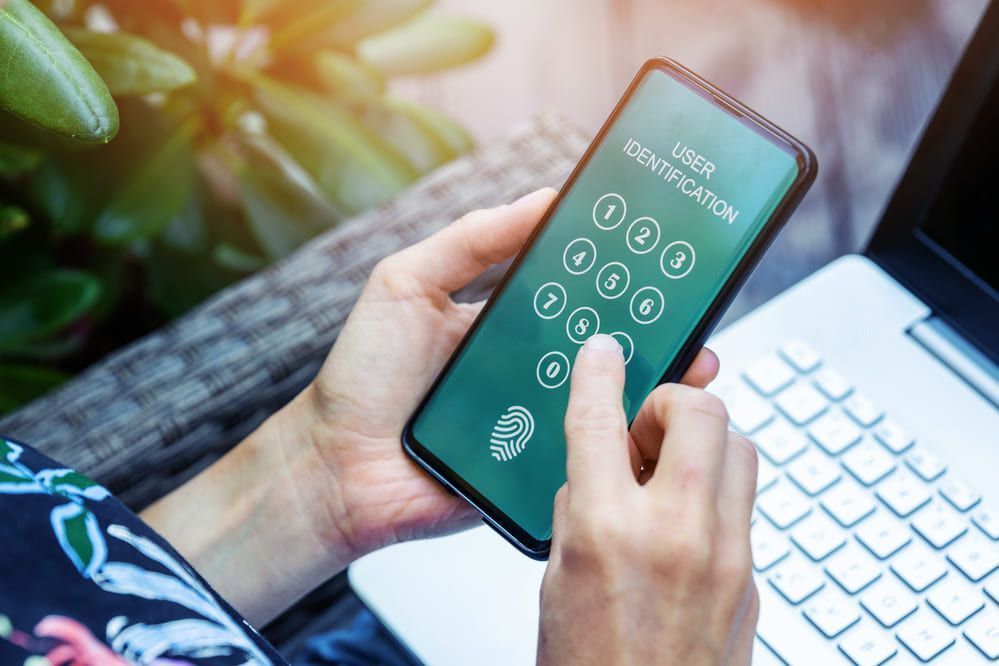
Data about you that tells the story of who you are. As personal as the image of your face or your fingerprint. Biometrics is responsible for collecting the data that identifies you as an individual. This is the information used to unlock your phone or confirm your mobile payments. Biometric technology is part of many of the most widely used banking applications today. In addition to delving into this technology that brings agility to processes, we also analyze how it works, its advantages, and some tips for its safe use. At Bizum, we like to keep you up to date: having useful information is the first step to enjoying full security.
More and more people rely on the individual physical characteristics provided by facial and fingerprint biometrics to identify them. Before moving forward, let’s clarify some terms:
Identification
This is the process of recognizing an individual within a group. To do this, the data of the person to be identified is compared with the aspects of each individual in the group. Your fingerprint or an image of you identifies you in relation to other people.
Authentication
This is the set of stages to prove that the identity claimed by a subject is true. This process compares the individual’s data only with the information associated with the requested identity.
Biometric data
This is the data that enables the identification of an individual and can be physiological, physical, or behavioral. Biometric data makes you a unique person and reveals more personal information than a password, for example. This includes the face, the iris of the eye, the voice, or the fingerprint.

We now understand that biometric data identifies us and differentiates us from others. But have you wondered where it ends up? The first thing you should know is that tech companies can neither use nor share it.
The storage of this information is local and is not uploaded to the cloud. It is usually stored in a memory separate from the device’s main memory. This security box ensures that this biometric data is kept safe. For this reason, after turning the mobile off and on, it is necessary to enter the password before anything else. This way, the chip where that data is kept is accessed first. Depending on your phone’s operating system, it is done in one way or another.

This is a chip isolated from the rest of the device’s hardware. In addition to guarding information about fingerprints or facial features, it also does so with information related to mobile payments. Within this processor, all information is encrypted.
iOS devices have an additional processor to the mobile’s main one that is unalterable and cannot be accessed, even if it were infected by some type of virus. iOS uses this security system on all its devices, whether they are phones, tablets, or smartwatches.

Let’s go back to a concept we saw earlier. By definition, a strong authentication system is one that requires at least two of the following pieces of data to be provided:
–Something you know
-Something you have
-Something you are
Biometrics would fall under the “something you are” section. Therefore, although it is a good method, it is not enough. If only biometrics is used, we are facing a weak authentication process, whereas using an access card and password is strong. To complete this strength in user authentication in banking applications, it is recommended to add to the biometric information user data and password as something known, or a digital certificate as something held.
Another option is OTP or One Time Password. It is common for this to be sent via SMS. But to avoid scams, fraud, and security breaches, the trend is to send that code or second authentication factor via a notification in the App installed on the verified device.

In any case, technological progress in security is so fast that a new standard already exists, called FIDO (Fast Identity Online). This is an online authentication technique that reinforces security on mobile devices and web applications. Its goal is to replace the exclusive use of passwords with more secure biometric authentication mechanisms protected by encryption systems. Some Spanish bank apps already use it. In this way, online trust is reinforced and access to the app is streamlined without the need to include digits or characters.
Some banking entities already use biometric parameters, not only to facilitate access to mobile banking, but also for signing operations, dispensing with the one-time password SMS. In this sense, the Spanish Data Protection Agency concludes that entities are within their rights to offer this technology to validate transactions, but only when users give their consent.
The truth is that biometrics is here to stay, bizumer. It streamlines procedures and allows payments to be faster. Your biometric information cannot be manipulated or modified. However, the AEPD provides us with more information to avoid confusion and problems and to use it in a 100% secure way.
More news,
because this doesn’t stop
-
International Bizum: everything you need to know
We know that Bizum is a much-loved project, both inside and outside our country. And this, dear Bizumer, is something we saw coming. That’s why, since the origins of its creation, we have worked with an international vision of Bizum in mind. In order for you to know everything there is to know about Bizum […]
Show more -
Who invented Bizum? We tell you the story
Dear Bizumer, we are sorry, but we cannot attribute the credit for the best invention of the century to a single person. And the fact is that Bizum is nobody’s idea, it belongs to everyone, it is the result of the collaboration of an entire sector. Already in 2015, 20 banking entities, Spanish together with […]
Show more -
How long does it take for a bizum to arrive, so fast that you don’t even see it coming!
Surely, on more than one occasion, you have wondered how long it takes for a bizum to arrive. Well, get ready to freak out, because the answer is: less than 5 seconds! Yes, you read that right. Less than 5 seconds. Sending a bizum is so fast that you could say that the money is […]
Show more